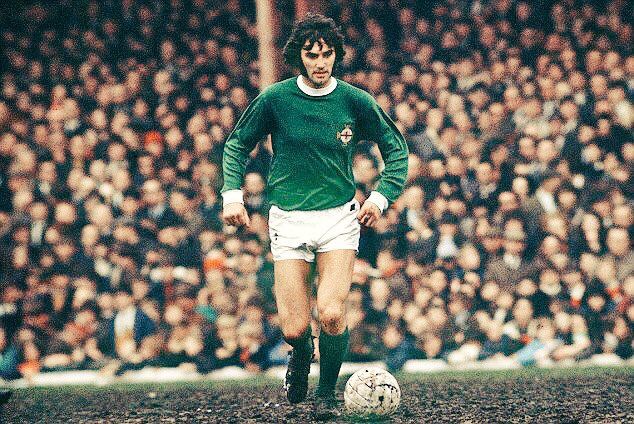
Today (22 May) marks what would have been the 80th birthday of George Best. Here the Irish FA looks back at some of the great moments that earned him legendary status.
In September 1963 George made his league debut for Manchester United in a home fixture against West Bromwich Albion. He was aged just 17, his debut coming just two years after he signed schoolboy forms with the Old Trafford club and moved from his home in Belfast to Manchester.
He first introduced himself to the world in March 1966 when Manchester United played Benfica in a European Cup quarter-final second leg in Lisbon. The then 19-year-old scored twice as United secured a 5-1 victory away from home.
The performance of the boy from East Belfast was so dazzling that the Portuguese media referred to him as ‘El Beatle’ (‘The Fifth Beatle’) - and the nickname linked to global pop sensations The Beatles became synonymous with the star forward.
Two years later, against the same opponents in the European Cup Final, Best scored the crucial goal in extra time. His neat finish helped secure a 4-1 victory for United.
Also in 1968 Best won the Ballon d’Or, becoming the first and only player from Northern Ireland to be named European Footballer of the Year.
Throughout the 1960s he was arguably the world’s greatest footballer, winning two league titles and a European Cup with Manchester United - and all that by the time he was 22.
He eventually called time on his United career in February 1974 after 468 appearances and 178 goals.
Stints in the USA, with Los Angeles Aztecs, Fort Lauderdale Strikers and San Jose Earthquakes, followed along with a successful spell at Fulham and another with Hibernian among others.
While Best produced several magic moments for his respective clubs, he was equally effective when donning the green of Northern Ireland. He won 37 caps for his country, scoring nine goals.
On the international stage Best and Pat Jennings both made their debuts for their country in a 3-2 British Home Championship win against Wales in Swansea on 15 April 1964.
Just seven months later Best’s first international goal arrived when he opened the scoring in a 2-1 World Cup qualifying defeat against Switzerland in Lausanne.
George himself believed his finest ever performance in a green shirt was the 1-0 victory over Scotland on a perfect autumn night at Windsor Park in October 1967. Best was unplayable that evening and only the sheer brilliance of Celtic goalkeeper Ronnie Simpson prevented him from getting on the scoresheet.
During a European Championship qualifier against Cyprus in April 1971 he set the record for the quickest hat-trick in the history of Northern Ireland’s senior men’s international team. Playing up front he scored three goals within the first 12 minutes of the match as the national team cruised to a 5-0 victory in Belfast.
Less than a month later Best produced one of the most famous ‘goals’ in the game, despite it not counting.
In a match against fierce rivals England at Windsor Park, goalkeeper Gordon Banks attempted to clear the ball. After he had thrown it up in the air, Best intervened and kicked the ball over Banks’ head and headed it into the back of the net.
However, the referee immediately blew his whistle and controversially disallowed the goal, stating Best’s actions amounted to “ungentlemanly conduct”. As a result England went on to win the match 1-0, with Northern Ireland missing out on the chance to be crowned British champions.
Five years later, in a World Cup qualifier against the star-studded Netherlands, Best produced a stellar performance in a 2-2 draw.
After coming out of international retirement, he impressed in Rotterdam, including nutmegging Dutch legend Johan Cruyff. What made that moment more iconic was that Best had told team-mates and the media before the game that he would do just that!
His final appearance for Northern Ireland came in a 1-0 reverse to the Netherlands at Windsor Park in October 1977.
Following his retirement, in 1983 at the age of 37, George worked in the media as a football pundit for a number of years before sadly passing away on 25 November 2005 aged just 59.